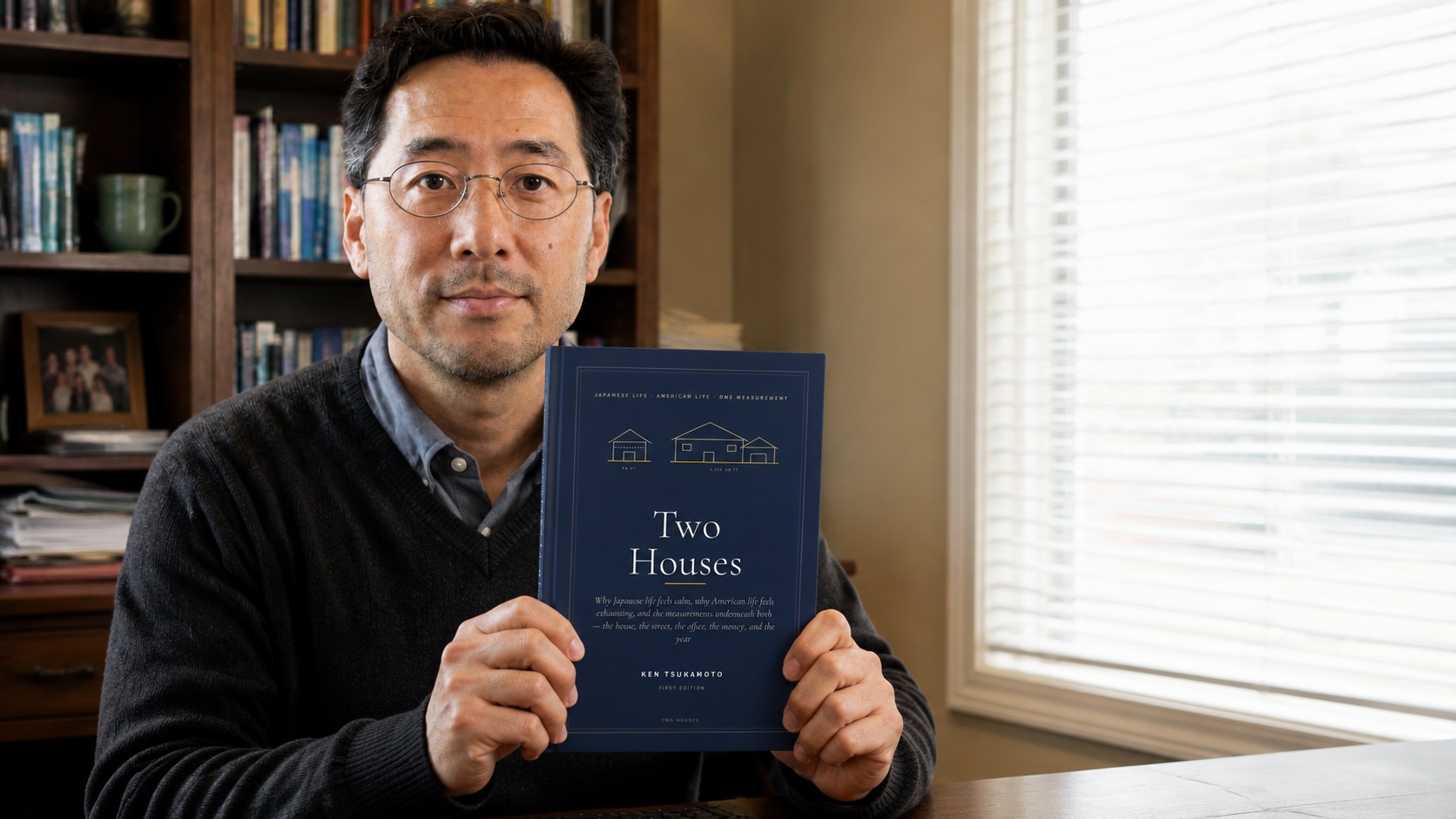
Ken Tsukamoto holding the book Two Houses with both hands

A book by Ken Tsukamoto

Two Houses

Japan never had anywhere to put the problem. America built somewhere. Everything else follows from that one sentence.

$47$79Early-bird price

543 pages · PDF · 30-day refund, no questions

Early-bird price — $47regular $79  ·  30-day refund, no questions  ·  Instant PDFGet the book →

Where it starts

I was twelve, in a friend's hallway, in my shoes and my coat, and something had gone quietly wrong.

There was no step. The house had no line in it anywhere — no place where the day ended and the home began.

Everyone here calls me Ken. My mother still calls me Kenichi. I have now lived in America longer than I lived in Japan, which makes me the wrong person to romanticise either country and the right person to measure the wall between them.

You have seen the videos where somebody folds a sweater into thirds and tells you to thank it. This is not that. Under every habit Americans call Japanese discipline, I found a floor plan, a law, a fee, a schedule, or a tax code that made the decision for everyone. And under every American habit I have never been able to explain — ice in everything, the mailbox at the end of the driveway, the garage door used as the front door — I found the same thing. A pipe. A code. A marketing department.

Nobody in either country chose any of it. That is the book.

Try it on one object, tonight

Every chapter ends on two questions.

Never the whole house. One drawer. One object. The fast answer is the true one — you have known it about most of what you own for years.

The two questions · master version
  1. If I didn't already own this, would I buy it again today, at full price, knowing what I know now?
  2. When I look at it, do I feel peace, or do I feel guilt?
RuleGuilt is not a reason to keep something. Guilt is the receipt.

Ninety-one pairs in the book — for the counter, the spare room, the sentence you say to your children, the purchase, the commute.

Two Houses, a navy hardcover, standing on a desk beside a cup and reading glasses

The book

Not philosophy. Measurements.

Ninety-six chapters, room by room, then out the door — the office, the school, the train, the street, the year, the elders, the grave, and the nine million empty houses Japan does not know what to do with. Set large, on the page, for people who are done squinting.

  • 543 pages, 96 chapters in 14 parts
  • 108 sourced measurements, each graded for how much weight it can bear
  • 92 memories from a Japanese childhood and an American adulthood
  • 25 things America does better, in one table
  • 91 two-question pairs, plus a printable ten-room house audit

Contents

Fourteen parts, from the front door to the empty house.

IThe HouseThe genkan, the room with three jobs, the 80 cm closet, one warm room, the spare bedroom, the lease, the deed, the balcony, thin walls, the earthquake.
IIThe KitchenWhat a counter is for, the convenience store as pantry, what a family drinks, breakfast, eating out, school lunch.
IIIThe Bathroom and the BodyThe bath order, the towel, shared air, the toilet room, where the family sleeps, laundry every day, shoes, the mask.
IVThe Twelve ObjectsTwelve things that fill an American home and sit nowhere in a Japanese one.
VThe HabitsPostponed decisions, addresses not storage, cleaning my own classroom at nine.
VICleaning and WasteSix bags and a calendar, the garbage bag that costs money, a country with no bins, what "clean" means.
VIIThe MoneyMy mother's ledger, the banknote, credit, tax, the pension envelope, the seal, why nothing is on sale, what a wedding and a funeral cost.
VIIIThe SentencesFour things Japanese parents never say, and the one they say more than anything.
IXFamily and SchoolThe uniform, the club, the exam ladder, the family register, the arranged introduction, the only child.
XThe Other DirectionTwenty-six American habits I still can't explain, and every concession to America in one table.
XIThe Table and the YearThe rice cooker as the clock, New Year, Obon, Golden Week, four seasons as a storage system, hanami.
XIIThe EldersCare insurance, the family grave, the funeral in full, the household altar, the empty house.
XIIIThe OfficeHired once, the lights stay on, the business card, the two-tier contract, the bar after work.
XIVGetting AroundThe city the train built, the kei car, the bicycle at the door, the $3,000 licence.
XVNeighbours and the StreetThe association, the clipboard, carrying the shrine, the police box, the umbrella that comes back, the apology.
+The System and five appendicesThe two questions in full, the room walkthrough, eight weeks, glossary, source ledger, myth register, house audit, cards.

Look inside

Every chapter has four things.

The Measurement

A number, a date, or a law, logged in the Source Ledger and graded Documented, Approximate, or Folklore. Where a popular claim has no source, I say so and take it off the table.

From the House

A memory. The rice being washed at four o'clock. The clipboard I carried next door for five years. The chopsticks at the crematorium.

Where America Is Right

The honest concession. Central heating, the mattress, the dryer, the credit file, the open road, the second chance, the casserole.

Two Questions

A pair you can ask of one object, one room, one bill, or one sentence tonight. Never the whole house.

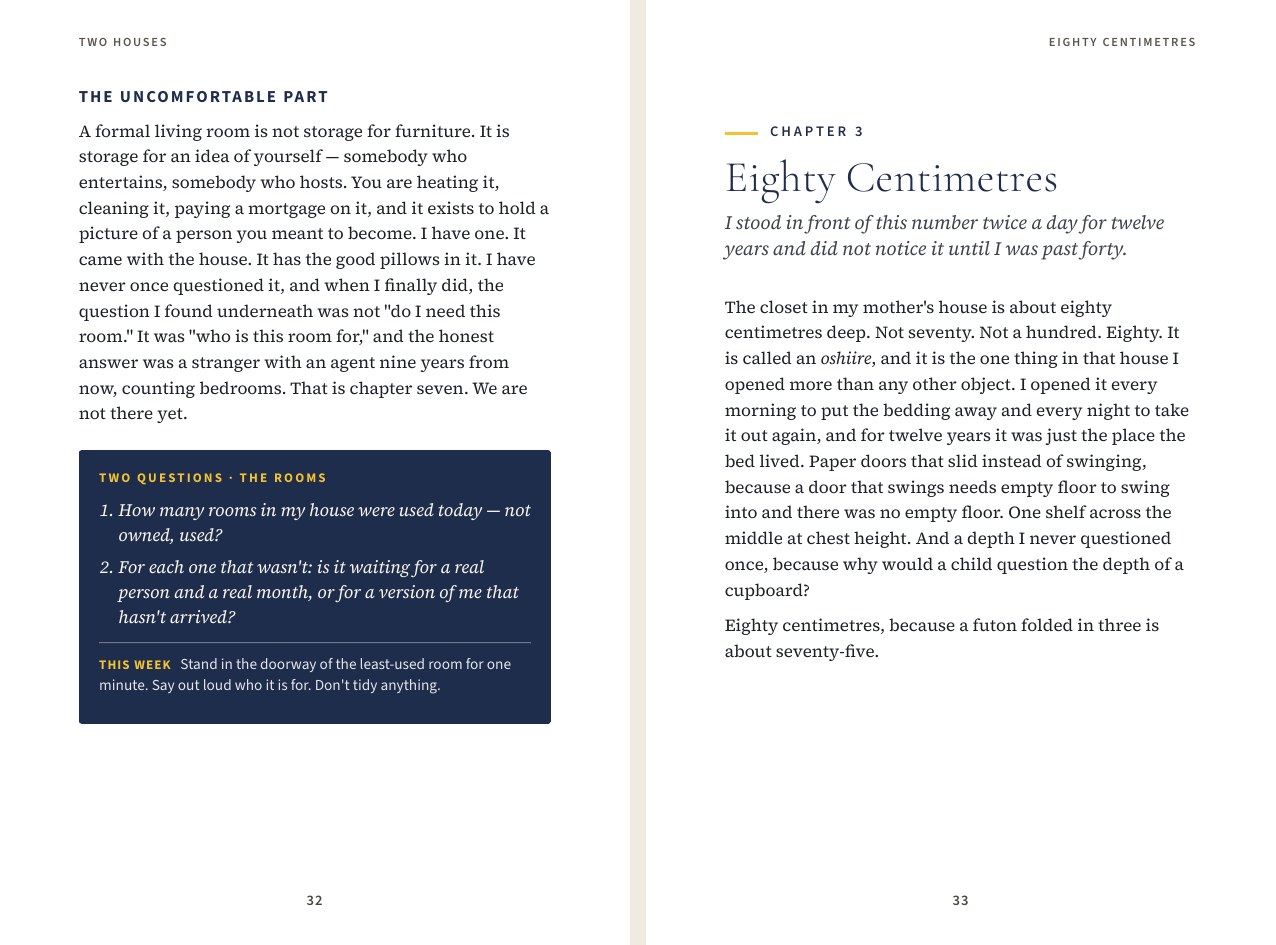
Interior spread from the chapter Eighty Centimetres
Chapter 3 · Eighty Centimetres
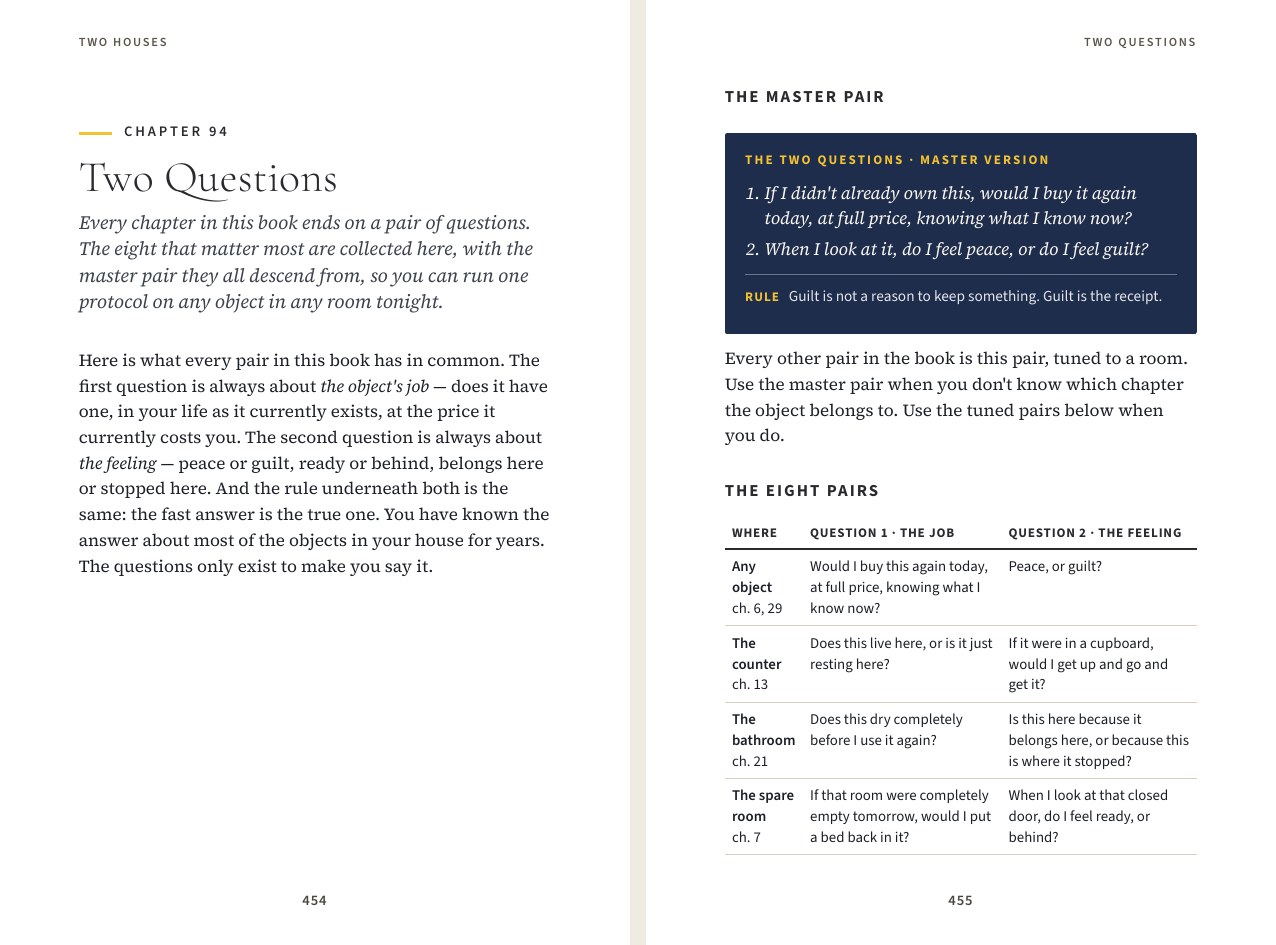
Interior spread from the Two Questions chapter
The System · Two Questions, with the master pair and the decision tree

Read this before you buy

What it is not.

  • Not a decluttering method. Nobody in this book thanks their socks. It explains why the clutter exists and gives you two questions for one object.
  • Not a philosophy. My mother folded the bedding every morning for twenty years and never once called it mindful.
  • Not "Japan good, America bad." Twenty-five things America does better, in my own words. I like my central heating.
  • Not medical, financial, or legal advice. The chapters on bathing, sleep, food, insurance, and elder care describe customs and payment rails. Nothing more.
  • Not my videos in book form. The channel has published a fraction of these ninety-six chapters.

From the comments on the channel

The voice you already know.

Real comments left on the videos this book grew out of. The book is that voice, at length, with the numbers.

Getting rid of one thing… there are so many, where do I begin? I'll start with a collection of video tapes, over a hundred that I know I'll never watch again. Thank you, Ken.

@Geekiezoid · YouTube

I like that you present facts but you don't judge. Excellent.

@SusanaBraylan · YouTube

I am an older American and I grew up with my mind being on what others would think. You've described it so clearly, like I have not heard it before. Thank you.

@MariaAnnRooney · YouTube

One of the most compelling videos about living, memory, philosophy and something I can't describe with American-English words. I'm grateful.

@theajane6444 · YouTube

Very therapeutic. Americans really need to listen to this. You gave a word for those feelings we have and being able to let go.

@francesvela5992 · YouTube

This is perfect and exactly what I needed. Thank you!

@SteveJones-o9y · YouTube
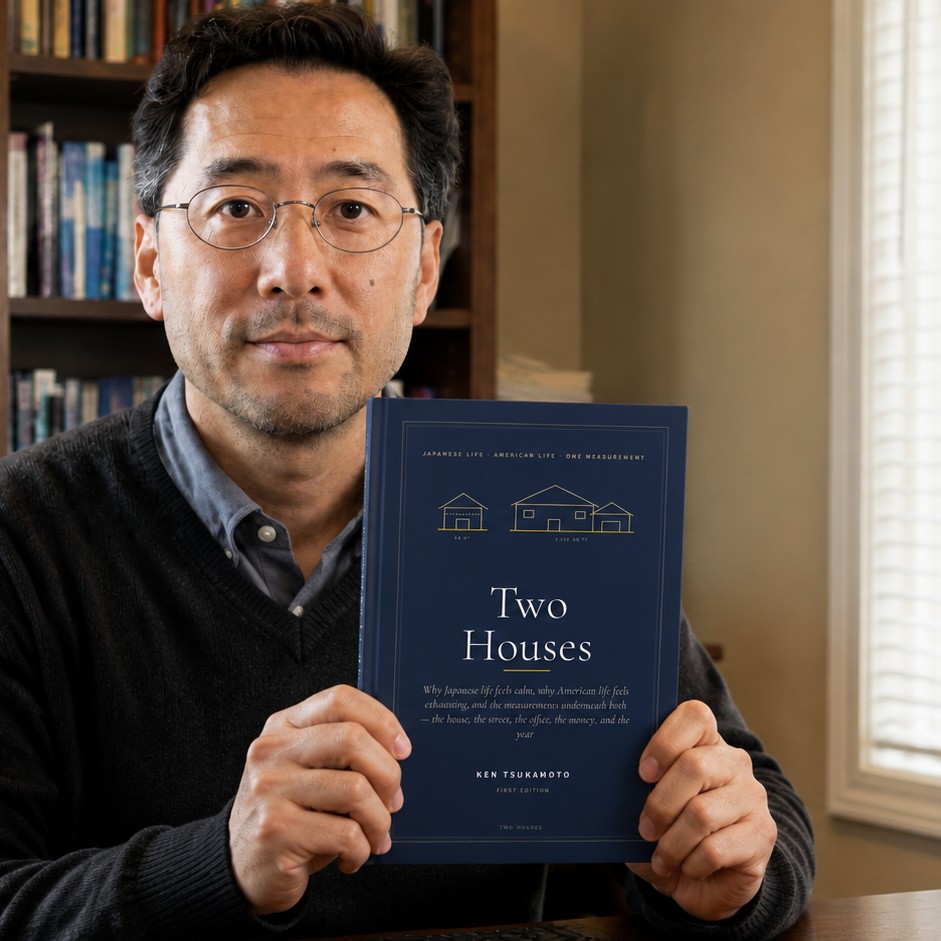
Ken Tsukamoto at his desk

Who wrote this

I am not the good example. I am the control group.

I got the full Japanese installation as a child — the step at the door, the classroom I swept myself at nine, the futon that came out of a closet every night, the ledger my mother wrote in pencil after dinner. Then I moved to a country where none of it runs, and I have had thirty years to watch which parts held, which mutated, and which died within a month of landing.

I own a garage that has never held a car, a bed I defend, central heating I love, and a kitchen drawer I could not describe under oath. I am writing from inside the American house, not from above it.

— Ken Tsukamoto · @kentsukamoto

Questions

Before you buy.

What exactly do I get?

A 543-page PDF, typeset at 6 × 9 inches for tablet or print. 96 chapters in 14 parts, the System (the two questions, a room-by-room walkthrough, eight one-week assignments), an 87-term glossary, the 108-entry Source Ledger, a 39-entry Myth Register, a ten-room printable House Audit, and ten cut-out question cards. Instant download from Gumroad.

Is this just the videos written down?

No. The videos cover a fraction of these chapters. Most of the book — renting, buying, the office, the school, the train, the neighbourhood, the year, the elders — has never been on the channel.

Are the numbers real?

Every measurement is logged in the Source Ledger with where it came from and a grade. Where a popular claim about Japan could not be sourced, it is marked Folklore and taken off the table in the text.

Is it hard to read on a phone?

It is set large on purpose. It reads well on a tablet, a laptop, or printed. On a phone it works in landscape; a tablet will treat you better.

What if it isn't for me?

Thirty-day refund, no questions. Email twohousesbyken@gmail.com and it is done.

Why is the price going up?

$47 is the early-bird price for the first readers. It moves to $79 when the launch window closes. If you are reading this, it has not yet.

Two Houses · First edition

One drawer. One object. Tonight.

You have known the answer about most of the objects in your house for years. This book exists to make you say it, and to show you the number that put them there.

$47$79Early-bird price
Get the book

30-day refund, no questions · Secure checkout on Gumroad · Instant PDF download

$47$79 early-bird
Get the book